In sight of Jody´s death, Janie finds
herself content with a life filled with freedom, one she had never been
familiar with. From a young age Janie had been controlled by Nanny and both of
her husbands, however their absence in her life after Jody dying lets her
experience a whole new way of living. She takes it in and although she is
pleased with her independence, she keeps it hidden from the town people´s agile
ears and judgmental tongues. Gradually
however, Janie does not care for the criticism she would receive. This is yet
another step in which Janie breaks down barriers of her former self, a Janie
that was preoccupied with other talk. It marks the start of this side of Janie,
until a reaching a complete transformation. We see in the beginning of the book
that when Janie comes back home in overalls she seems almost oblivious to those
speaking around her. Later
on, Tea Cake is introduced to the story, as he meets Janie and she quickly
notices his demeanor and sly way of talking. Another man in Janie´s life, but
this time it’s different and more towards the horizon than Janie will ever be.
When Tea Cake asks her to play checkers with her, it becomes a sign of what is
distinctive between him and the other men. He is respectful and unlike Jody, it
becomes apparent that Tea Cake sees Janie as an equal than an inferior. They
make their relationship public; again open to judgment that Janie ignores, once
again showing the growth in conquering her vulnerability. They move to
Jacksonville in promise of a life together. Though
Tea Cake cares for Janie more that the others, there is also this aspect of Tea
Cake, the gambling, his disappearances and how Janie falls completely gullible
to his words, that create a feeling of unease toward his character, a skeptical
view of what is to come for Janie and him. They soon move to the Everglades and
in chapter 15, when Janie experiences a grave feeling of jealousy overcome her,
watching Tea Cake and Nunkie flirt, we see the true toll of love and a sort of possession
that has taken over Janie. Janie meets Mrs. Turner, a
conceited and arrogant woman in her town that nonetheless befriends Janie. She
expresses her racist views toward black people, although being dark skinned as
well. She believes in race inferiority and believes that blacks are the ones to
fill that slot. Mrs. Turner´s character is a bizarre turn in the story, from
being racist towards her own race to controlling her husband; she seems to be the
epiphany of all Janie´s environment was not. When Mrs. Turner says Janie should marry her
brother, Tea Cake feels threatened by solely the suggestions and at the sight
of the brother in town, beats Janie in order to show his power over her.
Regardless of this unusual act of violence by Tea Cake, Janie does not show any
resentment. She is utterly in love with him to the point of dismissing the
flaws he bares. Later
on in the Everglades, very gradually, Tea Cake, Janie and other people from the
town observe as Native Americans travel up north. When asked why, they explain
that a storm is coming, news that is ignored by both Janie and Jody who refuse
to leave. The hurricane comes like the
Native Americans and many other immigrating had told both of them. It left the whole town in devastation and Tea
Cake watches in horror as the bodies are piled, segregated even at death,
coffins for those white and pits for those who are colored. During the hurricane
and their struggle Tea Cake had been bitten by a dog that later proves to have
been rabid, eventually affecting Tea Cake as he becomes paranoid and
delusional. He looses his sanity, slowly
and then all at once becoming wild. That is when Janie shoots him with the
rifle that he himself taught her to use. Janie is put on trial for murder but
as she speaks of her husband there is no doubt that this is a woman who loved Tea
Cake thus using herself as witness sets her free of charge. Now
that the journey that Tea Cake had offered Janie back in the Everglades was
done, she comes back home to Janie and sits at night to wonder about her life
back at the Everglades. Although her story ended with Tea Cake by her own hand,
she realizes that Tea Cake gave her that horizon that she so had been longing
since those days under the plum tree.
jueves, 26 de septiembre de 2013

miércoles, 4 de septiembre de 2013
Their Eyes Were Watching God: Chapter 4-8
In sight of having married Joe Starks through some what desperation and eagerness for a better horizon, Janie joins him on his search for business. They arrive at a small town, quickly finding their hopes dis-inflated at the sight of what they can barely call a town. However, this does not stop Joe from taking charge and he does so quickly. With his confidence and poise he hires men from the town to help him build his store, surely enough earning Joe the title of Mayor due to the absence of a former one. It is when he is named mayor that the first signs of faults to Joe’s character start showing. It not only become evident to us, but to Janie’s character as well. When the townspeople ask Janie, “Ms.Mayor”, to speak, Joe refuses and says there is no room for women making speeches. This reveals the sexism that lives inside Joe and that mentality we had not clearly seen before. This more thoroughly adds to the theme of gender roles that we see in the novel through Janie and the relationship with her first husband. Signs of Joe’s faults were given at first when introduced to his character. He told Janie right away about his business, foreshadowing his further infatuation with power rather than care for people, in particular Janie.

Joe states that the town needs a street lamp and it is through this that he creates a sense of pride for the townspeople toward their town. Regardless of the townspeople worries, Janie is still annoyed with Joe and his lack of time for her, obviously showing the cracks in her better horizon that she thought to be promised in the form of Joe. He possesses a dominant hand over Janie and tries to craft her into the woman he has in mind for himself.
In the store Joe makes Janie put her hair up with a rag, which in link, symbolizes his control over her as Janie’s hair in previous chapters had been depicted as her sexuality. The towns people comment on her hair and speak of the way Jody makes her put it up, metaphorically speaking, the author is referring to Janie's hair as her potential and the way she ties it up thanks to Joe, as her shackle. Later on, the level of Joe’s dominance over Janie grows and her resentment builds with it. He speaks of her incompetence at any slight mistake she might make, an ironic accusation since Joe’s power in particular is what is making Janie conform. Although the mule, which Joe buys to please Janie, may seem like an act of kindness, it is only attained through money, which in retrospective is just another portrayal of his obsession with power. Janie not only feels resentment for her husband but begins to hate the life she lives in its entirety and become exasperated.
Jody begins to deteriorate physically and emotionally, becoming sickly and vicious towards Janie all the same. Despite Janie’s hatred for her aging husband she calls for a doctor which informs her that Jody is soon to die. On his deathbed, Janie and him get into an argument which results in the complete breakdown of Joe’s character. Janie insults him and accuses him of his excessive dominance and ego, upon this Joe realizes the truth in her words and begs her to stop. He then dies and Janie’s first act is to release the rag that has tied up her hair for long enough. Through this act she reasserts her right and breaks the dominance that Jody had cast upon her. It is in this moment of confrontation and the death of her husband that a realization of self path is conquered.
jueves, 22 de agosto de 2013
Their Eyes Were Watching God: Chapter 1-3
In a small town down in the south, Their Eyes Were Watching God by Zora Neale Hurston begins with the trek of Janie Starks, toward the
porch of her loyal best friend Phoeby Watson. All eyes on her as she walks
through the town to seek comfort in the presence of her friend, the whisper of judgmental
thoughts, ring in her ear loud and clear. Becoming an immediate outcast after
rumors of her man leaving her and taking all of her money, eyes on her, remorse,
memories and the overalls she has on are the only things left for her to hold
on to. However, when Phoeby asks about the truth in the rumors, Janie rebukes
it and begins her recount of events; starting her story at a more naïve and
young version of Janie herself.


miércoles, 2 de mayo de 2012
Color Collective Poem
Silver Spring- Benjamin Moore
2120-70
Spring,
A bud, barely blossoming
She stares out
A bud, barely blossoming
She stares out
out her
window
in anticipation
Keen to sneak
out the kitchen door
she holds her
breath
one, two, three
lets it out,
back in
inhaling the
chilly air
(it hurts her
lungs)
When the
raindrops
make their way
to the icy branches
of the cherry blossom tree
to the icy branches
of the cherry blossom tree
She spends her
days
out,
in the wilderness
running free
in the wilderness
running free
Winter,
Just an ice
cold skeleton in her memory
she glides
through her silver spring.
she glides
through her silver spring.
Her mother
at the kitchen
sink
her father gone
the child, she seeks happiness
in the vanishing cold
the child, she seeks happiness
in the vanishing cold
her coat made
of nylon
She lets her pale
lips
kiss the frigid
air
and her bones weaken
She leaves those memories
and her bones weaken
She leaves those memories
to be
buried
in the ground
No more despair
No more despair
Her mouth
begins to feel dry
she slowly and
thoroughly
moves her still
damp tongue
Across her chapped,
cracked, colorless lips
The air begins
to numb
Her hands
She reaches for
the door knob
Back home
But her hand
slips off
And comes back
To her side
She decides to
sit on the stairs
The ones that
lead home
And a single
cherry blossom
Falls to her
feet
It lays
motionless
With a thin
layer of snow still under
Her hand
reaches out to it
And picks it up
There will be
others like it
Replacing the
snow
She reaches for
the door knob
And says
Goodbye to her
silver spring.
martes, 1 de mayo de 2012
Where I'm From

I am from slides and swings
From D’onofrio and Inca Kola
I am from the cross over every bed
Damaged, worn, carved, crafted from wood
And dipped in holy water.
I am from bugambilias
White, purple or pink
But always carry thorns
The ones I did not know of
Until I picked at one.
I am from homemade
Guanabana ice-cream on sweltering days
from short, small stature
Alicia and Regina
and the Merino family tree
I am from fast thinkers,
Jokesters and the prank players.
I am from you choose your own path and enjoy it while it last
From tracing the sacred symbol across my face and chest
Prayers I was told to keep in my heart
But I have lost
Lost and barely keep in my mind.
From Aji and rice
(No matter on what)
From the hearts my uncle used to break
And the kisses he would steal
The joy in my grandmother’s blind
But still, deep green eyes.
I am from the bronze frames on the wooden cabinet
Albums leaking abundance of memories,
And stolen photographs to greedily keep
Under the pillow,
Under the bed,
To salve the distance
Remember the lost faces
Cut, picked from the tree.
I am from Lima, Peru
But my heart,
It belongs to other places too,
I am from where I wish to be
the place that’s absence
Causes my melancholy.
I am from everywhere I have lived
every country I was ever referring to
when I whined, whimpered, whispered,
I want to go home.
From D’onofrio and Inca Kola
I am from the cross over every bed
Damaged, worn, carved, crafted from wood
And dipped in holy water.
I am from bugambilias
White, purple or pink
But always carry thorns
The ones I did not know of
Until I picked at one.
I am from homemade
Guanabana ice-cream on sweltering days
from short, small stature
Alicia and Regina
and the Merino family tree
I am from fast thinkers,
Jokesters and the prank players.
I am from you choose your own path and enjoy it while it last
From tracing the sacred symbol across my face and chest
Prayers I was told to keep in my heart
But I have lost
Lost and barely keep in my mind.
From Aji and rice
(No matter on what)
From the hearts my uncle used to break
And the kisses he would steal
The joy in my grandmother’s blind
But still, deep green eyes.
I am from the bronze frames on the wooden cabinet
Albums leaking abundance of memories,
And stolen photographs to greedily keep
Under the pillow,
Under the bed,
To salve the distance
Remember the lost faces
Cut, picked from the tree.
I am from Lima, Peru
But my heart,
It belongs to other places too,
I am from where I wish to be
the place that’s absence
Causes my melancholy.
I am from everywhere I have lived
every country I was ever referring to
when I whined, whimpered, whispered,
I want to go home.
And although at moments I feel
I am not there now
I know where I come from
From hugs and kisses and
Te amaré por siempre
I am from the arms of my family
That wrap around me
Like the sun does the day
I am not there now
I know where I come from
From hugs and kisses and
Te amaré por siempre
I am from the arms of my family
That wrap around me
Like the sun does the day
It always comes back to
where my heart
Wishes to be.
I know in those short moments
those magnificent moments of remembrance
I can‘t help but smile
But get that warm feeling in my heart
that I know
Where
I am from.

viernes, 27 de abril de 2012
Uncertain Living
"Those who do not remember the past are condemned to repeat it"- George Santayana
"No hay pasado ni futuro en la existencia, la existencia es solo presente."/ "There is no past or future in existence, existence is just the present."- Macaco
"No hay pasado ni futuro en la existencia, la existencia es solo presente."/ "There is no past or future in existence, existence is just the present."- Macaco
"The past cannot be changes; the future is yet in your power."- Mary Pickford

My mother told me to live in the present; that I shouldn’t look for the future or seek the past. However some days, minutes, years later I learned about this place called heaven; I’m sure you have heard of it: A place superior to earth, to anything, to anyone and the basics steps to get there were as simple as being good. But heaven as I’ve been told lays in the future, something I was once told not to worry about. Around this time I was taught by my mother herself that I was to learn from my past. And that’s when I became uncertain on the concept of living before, now or then. To follow mother’s teachings in their entirety I was to learn from my past, to think about heaven but still be able to live in the present. To learn from the past, live in the present and aspire for the future. At the end of the day, it’s really your decision how you want to live your life, past, present or future and for this reason I picked poems about living in every one of these, being able to captivate those who live or aspire to live in anyone of these tense.
jueves, 22 de marzo de 2012
Society Killed the Teenager
I barely turn on the news and it is only because of things like this. I’m afraid that I’ll find myself listening to tragic events where people like George Zimmerman kill innocent people (in this case a teen) and where young people like Trayvon Martin are killed. 17 year old Trayvon Martin was simply walking in Sanford, Florida, with nothing more than a bag of skittles in his hand, iced tea in the other and a hoodie over his head. However George Zimmerman shot him dead, claiming that the boy looked suspicious and that he only did it in an act of "self-defense".
Prejudice, unfortunately, is a part of our community and society: appearances are judged frequently and this is exactly what Zimmerman did. He judged Trayvon, simply and solely knowing what he looked like. Prejudice leads to injustice and it is evident when a black male in a hoodie is considered “suspicious” and a threat. It is evident when he is shot and killed, the murderer is not charged with manslaughter and the police department chooses to ignore the case.
The innocent deserve to live; however, sometimes they just don’t. Its the ugly truth, but we, as individuals have responsibilities in impeding events like this from happening. Discrimination shouldn’t be something we act upon,everyone deserves to feel safe and rights should be respected while we do everything we can to prevent harm. Although it isn’t much, it`s all we can do as individuals and all we can do to help.
As a child, i feared things i didn’t understand. I faced fears like monsters under my bed, in my closet, even the thought of a creature coming into my room and taking me away. But what i didn’t understand was that these were only figments that adults would speak of and which i portrayed as malevolent creatures. And if you think about it, adults do the same thing when stereotyping; they create an image for certain people and ,others, unaware, sucumb to believe in such accusations. And this seems to be the case when talking about the murder of Trayvon Martin. George Zimmerman acted upon those accusations;a black male in a hoodie is not automatically a threat. But just like a child, he feared something he did not understand and the result was tragic.
It hurts to know that innocent people are killed on a daily basis. That the world we live in is messed up and we, as individuals cannot change it alone. It’s something we cannot fight and take into our own hands. It hurts us one way or another, and it’s something that I’m afraid to say, will just get worse-- Society. I try to do my best for this world, and i keep my hopes up, waiting for someone, something to come along, to change people. Create a world where prejudice, racism and discrimination are absent and where equality, rights and freedom aren’t JUST things we claim to have, but truly are concepts our society is based on. But me, I’m one person in this planet, a planet that holds over another billion just like me. There really isn’t any other way to put it-- this world is messed up, and things like these just reinforce my point.
jueves, 15 de marzo de 2012
To Kill a Mockingbird: Anything But Usual
Later that winter Ms. Radley died; however it was barely a calamity as no one in town seemed to be affected in anyways. When Atticus came back from the Radley house Jem encourages me to ask about Mr. Arthur. I was meticulous to ask and right to do so knowing that interrogating Atticus wouldn’t get me anywhere but in trouble. But Jem pushed me and I said before, it got us nowhere.
Bizarrely, the usual, sweltering weather in Maycomb County was absent and instead we received what I thought to be the end of the world—Snow. It worked in my favor though, getting us successfully out of school for the entire day ahead. With no school to shackle us to a day of boredom Jem took this time to make nothing more than a snowman.
With the cold providing an imminent death for Miss Maudies plants, there was no dissension when Jem retrieved all of the remaining snow from her yard. But refusing to tell me or Miss Maudie what his exact intention was for the snow, it was only obvious he was conspiring to make more than just a common snowman.
As time elapsed and Jem’s creation was completed, I began to apprehend that he had made nothing more than an explicit snowman along the lines of Mr. Avery’s image. Atticus, however, asked Jem to make the similarities somewhat discrete, which only led to Jem taking Miss Maudies hat, and when putting it on the snowman, creating our very own Morphodite for our backyard.
Later that day the temperature dropped and with that I fell asleep, but in what seemed to be only minutes late I was woken up by Atticus’ voice. We ran out, assimilating into the crowd surrounding Miss Maudies house which was in flames. Atticus ordered us to over to the Radley’s house, away from the anarchy that had seemed to commence as the town crowded, everyone trying to catch a glimpse.
I, unlike the others, couldn’t watch; Miss Maudie was the only woman I could lionize, with other women, Miss Stephanie Crawford setting the example, there wasn’t many other options anyways. She was the only one I truly respected and the thought of her house in flames terrified me.
At dawn, after they assured the fire was out and Miss Maudie was okay we headed back home where Atticus pointed out the quilts over our shoulders. Although he was not mad, Jem acted as if he was being arraigned, as if being sentenced guilty for leaving the Radley place. He had gone mad defending himself, stating he had done nothing but follow Atticus’ instructions. Later on though, we came to the conclusion that there was only one person who was at the fire, only one person could have supplies is with the quilts—Boo Radley.
lunes, 5 de marzo de 2012
Dear Lily
Dear Lily,
I know it is peculiar to write twice to you in a week, but a bizarre feeling came over me, and I felt the urge to write once again.
Over here it is complete chaos. The court has gone into a state of anarchy. The number of occurring calamities is becoming larger and more frequent. Several people–more than the usual–have been arraigned and apprehended for committing crimes that I know for a fact they didn’t do. It hurts to see cells of prison filled with innocent people. Even with people like me as lawyers the injustice we saw everyday when we were children still occurs. I should have known that assimilating into a group of people who call themselves impartial, and are nothing but that, would not be imminent.
But, that isn’t the reason why the urge to write to you came. I understand now that a type of anger has been building up inside me; that the dissensions that I face everyday at court and the interrogations that are now meant to attack innocent people have been affecting me more then I would like. Lily, I’m not the same boy who promised he would come back for you 20 years ago.
So when I heard about you father–his death– I went back to those sweltering summer days when we would sit far out by the river and you would go on about the cruel man he was. How, at first, your mother had loved him and he had thought so much of her, lionized her. But as the years passed he stopped being the sweet, meticulous man who paid attention to everything your mother did, and started to become the T-ray you knew. You said it was because of building anger–anger that I, now feel.
For that reason, I do not think you or I should continue writing. I do not want to become T-ray–I don’t want you to become your mother. I don’t want years to elapse and with them, our love for each other. I want to think back and remember Lily, the girl I loved; not Lily, the girl to which I was only a shackle.
I love you more than you can imagine and although this is the final letter, it is not the final time I will think about you.
Sincerely,
Zach
jueves, 19 de enero de 2012
The Problem We All live with
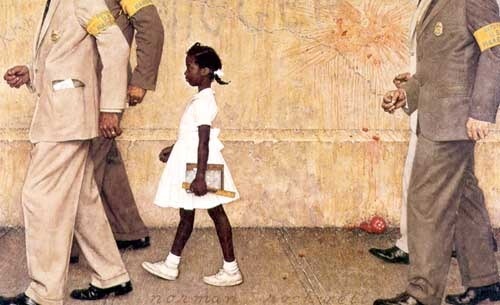
In 1964, 4 years after the Little Ruby Bridges scandal had started, Norman Rockwell painted The Problem We All live with. The painting depicts the scene in which a little African-American girl wearing a white dress, famously know as Ruby Bridges, who became one of the icons of civil rights and integration. She is walking to her recently integrated elementary school in the 1960’s. Around her there are 4 U.S Marshals which seem to be escorting her to elementary by their formation; two in front and two behind little Ruby Bridges.


But despite all of this, the facial expression that is registered on Ruby Bridges face is not an angry one, not even a worried one. It is a calm one, and looking closer, you can see her head is even held high. In a way, her body language matches those of the U.S Marshals, as it seems she is just playing along, being her own “little soldier”. It is a face of a naïve and innocent little girl, a girl who does not fully comprehend the hatred toward her. Even though the signs of hatred are portrayed obviously in this painting, thinking from the point of view of that little six year-old on November, 14, 1960, she is oblivious. Even a now grown up Ruby Bridges commented, “That girl in that painting, at six years-old, knew absolutely nothing about racism. I was simply going to school that day.”
Although I cannot speak for other people, I do believe that when looking at this Norman Rockwell painting, the first thing that impacts you is the cruelty, the hatred that was directed towards this little girl. After all, she was, in fact just trying to get to school. It shows that people went crazy with ignorance. THIS was not who they should have been throwing tomatoes at; in fact, no tomatoes should have been thrown AT ALL. And it is for that same reason that I think Norman Rockwell decided to paint this scene.


I believe that the reason he did go out of his comfort zone was because he wanted to make a point. That what these cruel and insensitive people were doing was UN human like; savage for that matter. It was simply not right to attack and innocent girl like that. And anyone who was sane and whole hearted would have known that. Other than that, the fact that the painting illustrates Ruby and not the crowd shows that he wanted to specifically show that this girl, with pig-tails and her little white dress was not a target. He is showing the importance of this brave six year-old, who although thought she was simply going to school, did so much more than just that.
sábado, 7 de enero de 2012
Travel Journal: Back to jUSt us
My brother and cousin our now gone, leaving me and my sister alone with my parents. It's what im actually used to, since my brother left when i was in 1st grade and my sister only left about two years ago. But them leaving also means one other thing...being bored. I mean when my dad asks if we want to go to corner store we run down those stairs like nobody's buisness. I mean its pretty exciting when all you do all day is sit around.SO imagine when he asks if we want to go get icecream; saying we get excited is an understatement.
When people visit us, even if its my brother or cousin ( I think my sister is the only exception) we always go out and visit places. But i guess that's over now. Its okay though, no pity for my boring life. I've got my sister, who is pretty good to be bored with. Except for when she hits me....or punches me...or pushes. But other than THAT...well, yeah, i guess its fine.



When people visit us, even if its my brother or cousin ( I think my sister is the only exception) we always go out and visit places. But i guess that's over now. Its okay though, no pity for my boring life. I've got my sister, who is pretty good to be bored with. Except for when she hits me....or punches me...or pushes. But other than THAT...well, yeah, i guess its fine.

miércoles, 4 de enero de 2012
Travel Journal: Dont take me out
Normally during vacation my family gets a little crazy about what we eat. During vacation, because my mom doesn’t want to cook at all, (and none of us have any chance of cooking without burning the house down, other than MY delicious quesadillas - _ -) she leaves no other choice but to go out and eat. And EVERY SINGLE vacation I feel like my family WANTS me to die of eating too much.
It always starts with a simple suggestion of going to eat at La Mar. Whenever we hear those two inoffensive syllables we are naturally happy. But after about a week the same word makes you want to cry and be happy at the same time.
Worst thing is that it NEVER stops its constant. Of course for the rest of my family its fine. People like my brother get hungry every two hours. But for me and my sister, every time they talk of going out we try to get out of it.
Every time we end up going anyways. Worst thing is that normally they ask for platters without consulting us. So when I and my sister are walking back to our table from the bathroom, we see a HUGE plate of samplers and realize its going in the same direction as us.
Honestly I’m only a tiny bit glad for my siblings to leave. I’m ready to go back to homemade meals. Even if it’s just rice and chicken; that okay with me.
PS: It’s so amazing how I'm writing about food, while everyone else’s travel journal has ACTUAL stories. So I’m sorry, this vacation hasn’t been the best.


Worst thing is that it NEVER stops its constant. Of course for the rest of my family its fine. People like my brother get hungry every two hours. But for me and my sister, every time they talk of going out we try to get out of it.
Every time we end up going anyways. Worst thing is that normally they ask for platters without consulting us. So when I and my sister are walking back to our table from the bathroom, we see a HUGE plate of samplers and realize its going in the same direction as us.

Honestly I’m only a tiny bit glad for my siblings to leave. I’m ready to go back to homemade meals. Even if it’s just rice and chicken; that okay with me.
PS: It’s so amazing how I'm writing about food, while everyone else’s travel journal has ACTUAL stories. So I’m sorry, this vacation hasn’t been the best.
lunes, 26 de diciembre de 2011
Travel Journal: Clear skies
My vacation so far hasn’t been exactly the most exciting; but today I woke up waiting for nothing more than a good day. Me and my family went all the way up to San Blas today and spent most of the day there. Of course no trip is ever perfect, at least not for me and my family. First of all, 5 in the morning? I wanted to throw the pillow at my dad for waking me up. I nearly fell asleep in the bathroom. The driver, ironically called Pacifico, picked us up at our house at about 5:30 and the whole way to San Blas he had on the loudest gospel music. In addition to that, he sang, THE whole way. Thank god for the loudest song on my i-pod and replay button. Other than that the day was good, no rain, clear water and clear skies all the way. I swear I could live at the beach.


 |
| San Blas 2011 Me and my sister |
jueves, 15 de diciembre de 2011
Lost Michaela
Michaela, she was known for being one of the few in her grade that was prudent and kept her grades up all year round. Unlike our lackadaisical classmates her enthusiasm and school spirit exceeded any of the teacher’s expectations. Of course if you met her after those few months of tragedy in her family, you wouldn’t have known her like that. You would have never suspected that behind those bad grades and rebellious attitude she used to be the teachers one and only favorite. At the start of 12th grade, the months past, she became troubled. Her respectful attitude turned into an audacious one that teachers did not like or appreciate.
I watched as more and more frequently, her serene manner in class disappeared as she would rankle teachers by mutiny against school work. No one knew exactly what had caused the recent change in this, before, conscientious girl. I knew though, her father had told me. I used to be her friend, that is, after all that had happened to her. But whenever in a principal’s, teachers, or counselor’s office (normally because they had confiscated things Michaela would pilfer from various students) they would ask her why she had become like this.
She would never specifically depict the reason, only give certain inklings. She’d answer the questions with something along the lines of “There is a profuse amount of events happening in my life” and would leave at that, leaving everyone clueless.
She found herself being rebuked by teacher’s everyday and just like me they grew despondent as to if she would ever go back to being the girl they all missed. On graduation day I watched from a distance as she sat among the parents, never having been able to graduate because of her slovenly class work. She sat watching as every single one of her classmates got on stage, received the award and stepped down. As I stepped up, I saw as she stood up and clapped the hardest she could, a smile on her face. I knew that girl I missed was somewhere, she wasn’t lost.
For more WW Stories, click here.
For more WW Stories, click here.
martes, 13 de diciembre de 2011
Confession Tuesday: Destiny killed the Cellphone
I confess that when my parents heard the loud noise of a cellphone falling down 4 flights of stairs, it didn’t entirely happen accidently. When my phone fell out of my pocket onto the floor, I was supposed to bend down and pick it up (something someone normal would do). But I stared at that piece of metal and plastic that I called my phone. So this is what happened, because that phone was everything I never wanted and because I’m particularly lazy on the weekends, I kicked it instead. Honestly I didn’t mean for it to go down the complete 4 flights of stairs,. Just one or two, I don’t know, maybe the phone wanted to die completely. Maybe it was destiny that the phone went all the way. But when it did fall all the way, i imagined my parents killing me.

To top it off I ran all the way down stairs only to find my mom staring at the phone blankly. I looked at her, then the phone, then back at my mom. I literally threw myself at the floor; hugging that phone as if it was my new born baby. I whined and moaned for my mothers sake, but inside all I could keep thinking about was, when’s my birthday? Oh right the 26th. Great, I guess that’s when I get my new phone. I was having a joy fest in my head as my mother called Dad to tirade me about the responsibilities of having a cellphone. All I heard at the end of that conversation was what my father whispered to my mother. “I guess we have to get her a new cellphone for her birthday, we were going to anyways.”
To read more Confession Tuesday click,here.
lunes, 12 de diciembre de 2011
Memoir Monday: Hugging Strangers
I don’t talk to my friends in Guatemala as much as I used to. I’m horrible in the concept of keeping in touch. And it’s not that my friends in Guatemala and me weren’t close, no. A lot of the time I wish I was still back in Guatemala being ridiculous with my friends there. And even though there is a lack of communication that I wish there wasn’t, I still think about them constantly. They haunt my mind, reminding me that I miss them.
I feel like they haunt me even at the mall, all the way over here in Panama. Yesterday as I walked out of the movie theater I stopped in my steps as I saw what looked like my friend, Alex.
Alex is the kind of friend that smiles at every moment of the day. Everyone has that friend that is constantly joking and in a cheerful mood ,well , that was Alex. And other than our names being the same, she and I were like the same person.
Alex is the kind of friend that smiles at every moment of the day. Everyone has that friend that is constantly joking and in a cheerful mood ,well , that was Alex. And other than our names being the same, she and I were like the same person.
So my initial reaction was to run up to her and hug her. But again, like I said before, it was what LOOKED like my friend Alex. But when you see a stranger on the street that looks EXACTLY like someone you really want to hug, your initial reaction is to do exactly that, hug them. Of course if it ISNT that person, you might go through a series of awkward minutes trying to explain why you hugged a complete stranger.
Luckily I didn’t have to go through those awkward minutes. But that girl, she looked so much like Alex that I just wanted to hug her for that fact. Just for looking like Alex.
When you find yourself wanting to run up to a complete stranger and hugging them, you know you might be a little crazy. But it made me realize, if I was willing to hug a complete stranger just because she looked like my friend, I probably miss Alex more than I thought I did. I wanted to give that complete stranger the type of hug you give your best friend the first day of school after summer. Those type of hugs that start with you walking towards each other but then transforms into a light jog because you are so anxious to see them after 2 months.
Oh God, imagine if I would have given her that hug. Probably would have thought I was trying to choke her.
But back to my initial point; I do miss Alex. I miss staying in the art room to turn the music up to the limit, I miss laughing to what nobody thought was funny, I miss making weird faces across the room.
Luckily I didn’t have to go through those awkward minutes. But that girl, she looked so much like Alex that I just wanted to hug her for that fact. Just for looking like Alex.
When you find yourself wanting to run up to a complete stranger and hugging them, you know you might be a little crazy. But it made me realize, if I was willing to hug a complete stranger just because she looked like my friend, I probably miss Alex more than I thought I did. I wanted to give that complete stranger the type of hug you give your best friend the first day of school after summer. Those type of hugs that start with you walking towards each other but then transforms into a light jog because you are so anxious to see them after 2 months.
Oh God, imagine if I would have given her that hug. Probably would have thought I was trying to choke her.
But back to my initial point; I do miss Alex. I miss staying in the art room to turn the music up to the limit, I miss laughing to what nobody thought was funny, I miss making weird faces across the room.
I remember the first time I noticed that Alex might be equally as odd as me. It was in the middle of class as we laughed silently to ourselves, on either side of the room, about a word that had sparked a whole train of inner jokes. Sometimes I still wish I could share those moments with Alex. Sometimes I wish she was here or I was there, just so we could laugh on either side of the room, silently, to ourselves. One of my best friends, and one of the strangest.
A Book Is Made to Be Read: Catcher in the Rye
The main reasons that Catcher in the Rye appears on so many school list as banned might have been more logical in the past. However in our time what was considered obscene and worth banning before are concepts that the children and youth today are more familiar with. The way Holden acts as a teenager might have been less realistic before but today it isn’t as unusual as it was before.
The reasons for which it is banned like the language, prostitution, sexual references and obscenities are things that teenagers already know about. Children aren’t as innocent as they were before and if the reason that it is banned is because of those things then it is absurd because if not already, eventually, children will stumble upon these topics. Banning the book for these reasons will not prevent the children to encounter the concepts that are shown.
The book is relevant to the teenagers of our time. The issues that Holden comes across are those that many teenagers face and happen frequently today. For example, the youth going against the authority, not wanting to grow-up, being rebellious and trying to find where you belong. It is also a coming of age book and teenagers today can relate while reading it.
Many schools along the south of the U.S have banned it for being “anti-white”, for going against the “perfect” image of an American family. It is close minded to ban a book just because it goes against that unrealistic idea of everything being perfect. But I believe the children should at least have the option to read the book. They should decided if they want to or don’t want to read the book of their choice.
The House on Mango Street

The house on Mango Street is not her home, Esperanza dreamed of so much more. Her parents would tell her about the house they would eventually own for themselves, a good life style. But unlike the house that her parents mention, this house lies of Mango Street; it’s a sad red house with small spaces and the bricks, that are supposed to be compact, crumbling. Her neighborhood is filled with neighbors who are evidentially not
wealthy; many of them showing the same cultural background as Esperanza and her family.
While living there Esperanza is surrounded by many female figures. But all of them have been tamed. All have been tamed by their husband or father. She tells about her great-grandmother, who she is named after. She was a “wild horse of a woman” but when Esperanza’s great-grandfather became her husband all that freedom and independence was thrown out the window. She sat at the window all her life thinking of what could have been, never forgiving Esperanza’s great-grandfather. And like her great- grandmother, many of the women in Esperanza’s family and on her street share the same story. “I have inherited her name, but I don’t want to inherit her place by the window” (11) This is one of the lines that I like most in this memoir because It shows Esperanza starting to be independent and knowing what she wants in the future. It shows the path she wants to take is a successful one unlike most of the women around her.
Esperanza knows of women who cry into the night, cry for their home, women that are abused by their father or husband, women that sit at their window wishing for more. And it is these women that impel Esperanza to wanting more. Esperanza knows that her future does not consist of any of these things. She doesn’t want it to consist of any of these things, she wants to be free, make her own profit; she does not want to be tamed, stopped by anything or anyone. She then realizes what will set her free is her writing. What had been just a pass time and something she enjoyed doing would be her future and hope of exceeding the expectations there was for a women in her neighborhood and culture.
At the end of the book it is truly Mango Street that has changed Esperanza. The people there have shaped her dreams and hope of becoming a free woman. At the end of the day, Esperanza decides, the house on Mango Street is truly her home. Where she will come back to after many years, and think of as her childhood, where she belongs. “They will not know I have gone away to come back.”(110)
jueves, 27 de octubre de 2011
The Legend of Sleepy Hollow
The Legend of Sleepy Hollow takes place in a Dutch settlement, where Ichabod Crane lives. Ichabod was a tall,lanky man who had fallen deeply in love with Katrina Van Tassel. But Katrina's beauty and affability lead Brom Bones to fall in love with her as well.
While Ichabod Crane was wise and sage, Brom Bones had nothing other than his appearance and was nowhere near being as profound as Ichabod. Seeing that Ichabod was also competing for Katrina's love, Brom began to abhor him.
One night Katrina's father organized a fest at which Brom and Ichabod were invited and attending to. Brom was very irascible and at the first sign of Ichabod and Katrina interacting and dancing he became furious. But refusing to become despondent, he pulled Ichabod aside and told him the story of the Headless Horseman, the spirit that haunted the Sleepy Hollow Woods.
Ichabod, being the superstitious man that he was, left the party tremulous that he might find on his path home through the woods, the Headless Horseman. On his way home Ichabod, finding his fears becoming reality, heard the laughter of the Headless Horseman reverberate off every corner of the chilling woods.
Ichabod Crane was never seen again and although the author never officially states it, it is believed that Brom's jealousy had impelled him to dress up as the Headless Horseman and scare Ichabod off.
After there were no more signs of Ichabod, Brom, taking advantage, entreated Katrina to become his wife. Soon enough Brom Bones and Katrina Van Tassel were married.
While Ichabod Crane was wise and sage, Brom Bones had nothing other than his appearance and was nowhere near being as profound as Ichabod. Seeing that Ichabod was also competing for Katrina's love, Brom began to abhor him.
One night Katrina's father organized a fest at which Brom and Ichabod were invited and attending to. Brom was very irascible and at the first sign of Ichabod and Katrina interacting and dancing he became furious. But refusing to become despondent, he pulled Ichabod aside and told him the story of the Headless Horseman, the spirit that haunted the Sleepy Hollow Woods.
Ichabod, being the superstitious man that he was, left the party tremulous that he might find on his path home through the woods, the Headless Horseman. On his way home Ichabod, finding his fears becoming reality, heard the laughter of the Headless Horseman reverberate off every corner of the chilling woods.
Ichabod Crane was never seen again and although the author never officially states it, it is believed that Brom's jealousy had impelled him to dress up as the Headless Horseman and scare Ichabod off.
After there were no more signs of Ichabod, Brom, taking advantage, entreated Katrina to become his wife. Soon enough Brom Bones and Katrina Van Tassel were married.
martes, 4 de octubre de 2011
Johnny's Mitt
Johnny was my younger brother. He was a baseball player and when I say baseball player I don’t mean a mediocre one; that would be an understatement. He was good, really good.
But his excellence didn’t stop there. He shined in so much more. Just like his fiery red hair shined from miles away. In academics he would excel the teacher’s expectations every time; they would always rave on about how smart of a boy he was. And he was too, he really was. Even though he was two years younger than me, his intelligence was superb to mine.
But back to him being a baseball player. He wore this baseball mitt, and boy did he love it. Honestly, back then, I didn’t know what he found so special about that particular mitt. But it was very important to him, his most prized possession. On the mitt he had written poems. Words flowed all over it. I remember watching him writing, he would write all through the mitt’s pocket and fingers. Just take out that green marker and continuously mark down his own poetry.
During games he would look down at the glove, every time. He reads the poems and then plays. He would read the poems I mean, Johnny is gone. And that insignificant mitt that I found no importance to when Johnny was alive is now mine. The mitt in whole is mine. With poetry and all, the only remains I have of Johnny is that mitt.
But his excellence didn’t stop there. He shined in so much more. Just like his fiery red hair shined from miles away. In academics he would excel the teacher’s expectations every time; they would always rave on about how smart of a boy he was. And he was too, he really was. Even though he was two years younger than me, his intelligence was superb to mine.
But back to him being a baseball player. He wore this baseball mitt, and boy did he love it. Honestly, back then, I didn’t know what he found so special about that particular mitt. But it was very important to him, his most prized possession. On the mitt he had written poems. Words flowed all over it. I remember watching him writing, he would write all through the mitt’s pocket and fingers. Just take out that green marker and continuously mark down his own poetry.
During games he would look down at the glove, every time. He reads the poems and then plays. He would read the poems I mean, Johnny is gone. And that insignificant mitt that I found no importance to when Johnny was alive is now mine. The mitt in whole is mine. With poetry and all, the only remains I have of Johnny is that mitt.
Suscribirse a:
Entradas (Atom)